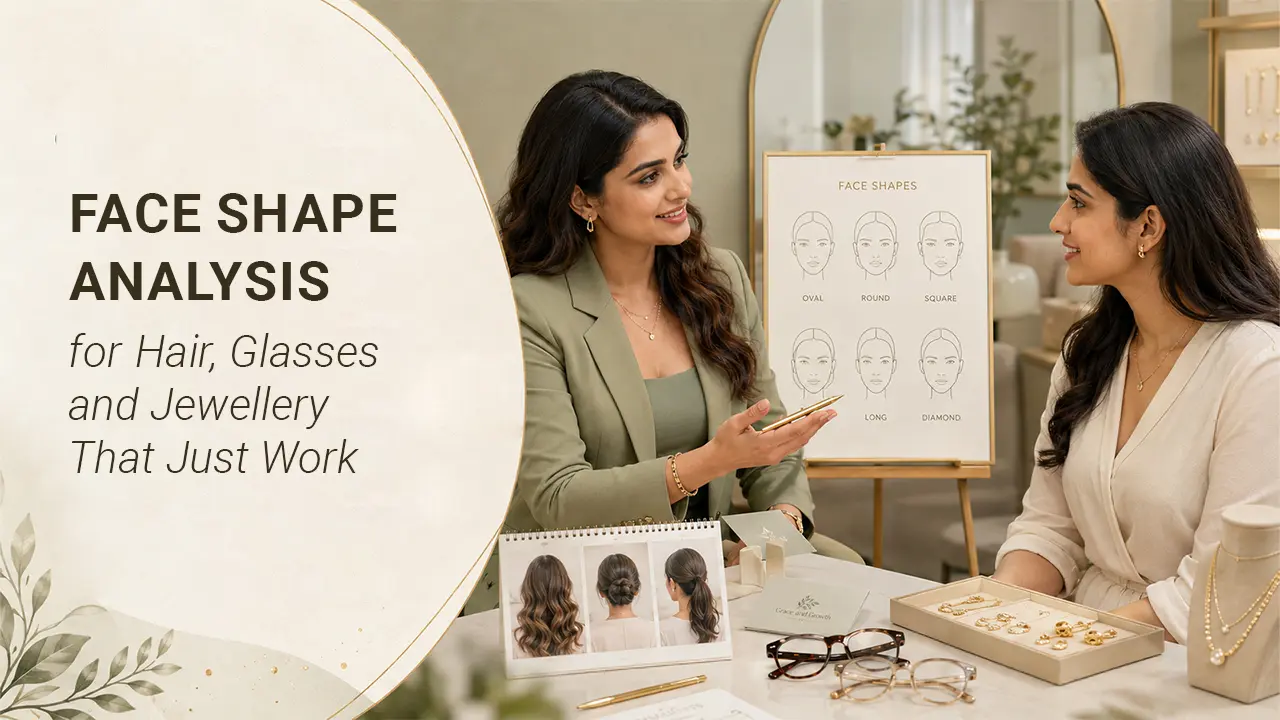
You’ve probably had this happen. You walk into a salon with a photo of a haircut you loved on someone else, and it comes out looking almost nothing like you imagined. Or you buy a pair of sunglasses everyone was raving about, only to feel like they’re wearing you instead of the other way round. It’s rarely the haircut or the frame that’s at fault. It’s usually that the piece was never chosen with your face shape in mind to begin with.
That’s exactly what face shape analysis solves. It’s a simple, practical way of understanding your face’s natural proportions, the width of your forehead and jaw, the length of your face, how sharp or soft your angles are, so that your hair, eyewear and jewellery work with your features instead of against them. Once you know your face shape, a lot of the guesswork around “what suits me” quietly disappears.
This guide walks through what face shape analysis actually means, how to identify your own face shape, and specific, practical recommendations for hairstyles, eyewear and earrings for every shape.
Why Getting This Right Is Harder Than It Looks
A few things most of us have experienced at some point:
- A haircut that looked effortless on your favourite influencer somehow adds width or length in all the wrong places on you.
- You default to the same one or two earring styles because you’re not sure what else actually suits your face.
- Sunglasses either feel too small and pinched or too large and overwhelming, and finding the “just right” pair feels like luck.
- Hairstylists give you a cut based on what’s trending that season, not on what actually balances your features.
- You can’t quite explain why a certain hairstyle or accessory makes you look more awake, more polished or simply more like yourself, and why others don’t.
None of this is about symmetry, beauty or some universal ideal. It comes down to proportion, plain and simple, and it’s one of the first things we look at with our Face Shape & Feature Analysis clients. Once you know your face shape, choosing a hairstyle, a pair of glasses or a set of earrings stops being trial and error at the salon or the store.
What Is Face Shape Analysis?
Face shape analysis is the process of identifying the natural proportions of your face, mainly the width of your forehead, cheekbones and jaw, the length of your face, and how angular or rounded your jawline is, so you can make more informed choices about hairstyles, eyewear, earrings and even makeup.
It isn’t about fitting your face into a rigid category. Most faces are a blend of two shapes, and that’s completely normal. What face shape analysis gives you is a general sense of where your face is widest, where it narrows, and how long or short it reads visually, so you have a starting point whenever you’re picking a new haircut or trying on a pair of glasses.
Why Face Shape Analysis Matters for Personal Styling
A haircut or a pair of earrings can change how balanced and put-together your whole look feels, and the reason is almost always proportion, not the trendiness of the style itself. Understanding your face shape helps you:
- Choose hairstyles that actually suit you, instead of copying a cut off social media and hoping for the best.
- Shop for eyewear faster, because you already know which frame shapes tend to work for your face.
- Pick earrings that flatter rather than compete with your features, especially for weddings and festive occasions when jewellery takes centre stage.
- Feel more confident in photos, since the right proportions around your face read well from every angle.
This is the same logic behind personal styling for women: once you understand your own proportions, whether that’s your face, your body or your colouring, every styling decision gets easier.
Common Face Shapes and How to Identify Yours
There’s no single “correct” way to categorise face shapes, and plenty of faces sit somewhere between two categories. Still, most styling frameworks work with some version of the following six.
| Face Shape | General Characteristics | Styling Goal |
| Oval | Balanced proportions, slightly narrower at the jaw than the cheekbones, gently curved | Maintain balance, most styles work well |
| Round | Similar width and length, full cheeks, softly curved jawline with no sharp angles | Add length and definition |
| Square | Strong, angular jawline, wide forehead, minimal curve at the jaw | Soften angles, add curve |
| Rectangular / Oblong | Longer than it is wide, straight cheek line, forehead and jaw of similar width | Add width, reduce visual length |
| Heart | Wider forehead and cheekbones, narrowing to a pointed or narrow chin | Balance the narrower jaw with width lower down |
| Diamond | Narrow forehead and jaw, widest at the cheekbones | Soften cheekbone width, add width at forehead and chin |
A quick way to get a rough sense of your own shape: pull your hair back, look straight into a mirror, and notice which is more prominent, your forehead, cheekbones or jawline, and whether your face reads longer than it is wide. This is a useful starting point, but a trained eye also looks at your hairline shape, chin length and how your features sit together, which is why a professional face shape analysis session tends to be far more accurate than a mirror check or an online quiz.
Best Hairstyles for Every Face Shape
Hair frames your face more than almost any other styling choice, which makes it one of the highest-impact places to apply face shape analysis.
Hairstyles for Oval Face Shapes
Oval faces are naturally balanced, so most lengths and cuts work well here, from a blunt bob to long layers to a full fringe. The main thing to avoid is a style that adds too much width at the cheekbones, since that’s the one area you don’t need to emphasise further.
Hairstyles for Round Face Shapes
Look for styles that add length and angles: long layers, a side-swept fringe rather than a blunt one, and volume at the crown rather than at the sides. Avoid chin-length blunt bobs and centre partings, which tend to emphasise width and roundness.
Hairstyles for Square Face Shapes
Soft layers, waves and side-swept styles work beautifully here, since they take the edge off a strong jawline. A side parting also softens the face more than a centre parting does. Very blunt, geometric cuts tend to echo the angularity of the jaw rather than balancing it.
Hairstyles for Rectangular or Oblong Face Shapes
Styles with width and horizontal movement help here, think soft waves, a fringe that sits just above the brows, or layers that start around the chin rather than falling straight down. Very long, straight, middle-parted hair tends to add even more length to an already long face.
Hairstyles for Heart Face Shapes
Side-swept fringes, chin-length bobs and styles with volume near the jaw help balance a narrower chin against a wider forehead. Very high, swept-back styles can expose more forehead than the face needs.
Hairstyles for Diamond Face Shapes
Styles with soft volume at the forehead and chin work well, such as a side fringe or a chin-length cut with waves. Sleek, middle-parted styles pulled straight back tend to highlight cheekbone width rather than softening it.
Best Eyewear for Every Face Shape
The right frame shape does for your face what the right blouse does for your body: it brings balance rather than competing with your natural proportions.
Eyewear for Oval Face Shapes
Most frame shapes work here, though geometric and angular frames, like rectangle or wayfarer styles, tend to add welcome definition to an already balanced face.
Eyewear for Round Face Shapes
Angular frames such as rectangle, square or geometric shapes add the definition a round face doesn’t naturally have. Round or oval frames tend to echo the face’s roundness rather than balancing it.
Eyewear for Square Face Shapes
Round or oval frames soften a strong jawline beautifully. Cat-eye frames also work well, since the upward angle draws attention toward the cheekbones and away from the jaw.
Eyewear for Rectangular or Oblong Face Shapes
Oversized or wider frames add welcome width, and frames with some depth, rather than a thin, narrow shape, help shorten the face visually. Very narrow, small frames tend to elongate the face further.
Eyewear for Heart Face Shapes
Frames that are wider at the bottom or lightly rimmed, like cat-eye or light aviator styles, balance a narrower chin against a broader forehead. Heavily embellished top frames can add unwanted width where the face is already widest.
Eyewear for Diamond Face Shapes
Cat-eye and oval frames work particularly well, since they soften cheekbone width and draw a little more attention to the eyes. Frames with detailing along the brow line also help balance a narrower forehead.
Best Earrings for Every Face Shape
Earrings sit closer to your face than almost anything else you wear, which is exactly why the right shape can make such a visible difference, especially for festive and bridal looks.
Earrings for Oval Face Shapes
Nearly every earring style works well on an oval face, from studs to chandeliers to hoops. This is one shape where you can let personal preference take over.
Earrings for Round Face Shapes
Long, angular earrings such as drops or dangles add the length a round face benefits from. Round studs or hoops tend to reinforce the face’s natural roundness rather than balancing it.
Earrings for Square Face Shapes
Rounded or curved earrings, like hoops or teardrop styles, soften a strong jawline. Sharp, geometric earrings tend to echo the angularity that’s already present.
Earrings for Rectangular or Oblong Face Shapes
Earrings with width, like studs, buttons or short chandeliers, work better here than long, narrow drops, which can add even more length to the face.
Earrings for Heart Face Shapes
Earrings that are wider at the bottom, such as teardrops or chandelier styles, balance a narrower chin nicely. Very small studs can get visually lost against a wider forehead.
Earrings for Diamond Face Shapes
Earrings with width at the top, like button earrings or studs with a wider top edge, soften cheekbone width. Long, narrow drops tend to draw the eye straight to the cheekbones instead.
Common Face Shape Styling Mistakes to Avoid
- Choosing a hairstyle purely because it’s trending, without checking whether it suits your face’s proportions.
- Sticking to the same one or two earring styles out of habit, rather than experimenting within what actually suits your face shape.
- Buying eyewear based on what looked good on the mannequin, instead of trying it against your own face shape and features.
- Assuming a fringe or parting style is fixed forever. Small adjustments here often make a bigger difference than a full haircut.
- Ignoring how your hairstyle, eyewear and earrings work together. All three sit close to your face, and styling them without considering each other can throw off the balance you’re going for.
Face Shape Is a Styling Guide, Not a Rule
No face shape is better or more desirable than another, and face shape analysis was never meant to change your features or push you toward one “ideal” look. Oval, round, square, rectangular, heart or diamond, every face shape has hairstyles, eyewear and earring styles that suit it well.
Use face shape analysis as a reference, not a restriction. It gives you a sensible starting point when you’re staring at a hairstyle board or an eyewear shelf feeling unsure, but there’s always room to experiment, break away from the “recommended” list, and choose what makes you feel most like yourself.
How Professional Face Shape Analysis Can Help
A mirror check or an online quiz gives you a rough idea, but face shape is genuinely tricky to assess on your own, mainly because we tend to see our own faces less objectively than a trained eye does. Hairline shape, chin length, cheekbone prominence and how your features sit relative to one another all factor in, and these are hard to judge accurately without an outside perspective.
A professional face shape analysis session usually starts with a conversation about your current hairstyle, eyewear and jewellery choices, followed by a structured assessment of your face’s proportions and practical recommendations across hairstyles, eyewear and earrings. What you walk away with isn’t a generic style chart. It’s guidance specific to your features that you can actually use the next time you’re at the salon, trying on frames, or shopping for festive jewellery.
How Grace & Growth’s Face Shape & Feature Analysis Can Help
At Grace & Growth, our Face Shape & Feature Analysis service helps you make your face the frame for your personal brand. Led by founder Mansi Mehta, the process covers the best hairstyles, eyewear and earrings for your features, along with how necklines and accessories can bring further balance to your face.
You won’t get a one-size-fits-all style chart. The analysis is built around your actual features and translated into practical, wearable recommendations. Many clients pair this with our Personalised Colour Analysis and Grooming Essentials & Everyday Makeup services for a complete picture, and with a body shape analysis and styling session for guidance that covers your whole silhouette, not just your face.
If you’ve ever stood at a salon or an eyewear counter unsure of what actually works for you, a personalised face shape analysis session with a trusted image consultant in Mumbai might be exactly the clarity you need.
Ready to find what actually suits your features? Book your Face Shape & Feature Analysis consultation with Grace & Growth today and stop guessing at the salon.
Frequently Asked Questions
- What is face shape analysis? Face shape analysis is the process of identifying your face’s natural proportions, mainly the width of your forehead, cheekbones and jaw, and the overall length of your face, so you can choose hairstyles, eyewear and earrings that suit your features.
- How do I identify my face shape at home? Pull your hair back, look straight into a mirror, and notice which is most prominent, your forehead, cheekbones or jawline, and whether your face reads longer than it is wide. This gives a rough idea, though a professional assessment is more accurate.
- Does face shape analysis mean some face shapes are better than others? No. Every face shape can look balanced and polished with the right styling choices. Face shape analysis is a tool for understanding proportion, not a ranking of which shapes are more desirable.
- What is the most versatile face shape for hairstyles? Oval faces tend to suit the widest range of hairstyles because their proportions are naturally balanced, though every face shape has several styles that work well for it.
- How do I choose eyewear for my face shape? As a general rule, frame shapes that contrast with your face shape tend to work best, angular frames for round faces, rounder frames for square or angular faces, and wider frames for longer faces.
- Do earrings really need to match my face shape? Yes, to an extent. Because earrings sit so close to your face, their shape and length can either balance or exaggerate your natural proportions, which matters even more for festive and bridal jewellery.
- Can my face be a mix of two shapes? Yes, and this is extremely common. Most faces lean toward one shape while borrowing characteristics from another, which is exactly why a professional assessment is more useful than trying to force yourself into a single category.
- Is face shape analysis only about hairstyles? No. While hair is often the first thing people think of, face shape analysis also guides eyewear, earrings, and even how necklines and makeup can bring further balance to your features.
- How often should I revisit my face shape styling choices? Your underlying face shape stays fairly stable, but hair length, styling trends and personal preference all change over time, so many people find it useful to revisit their guidance every couple of years or after a major hair change.
- How long does a professional face shape analysis session take?
- How is face shape analysis different from body shape analysis? Face shape analysis focuses on hairstyles, eyewear and earrings suited to your facial proportions, while body shape analysis focuses on clothing silhouettes for your body’s proportions. Many clients combine both for a complete personal styling profile.