
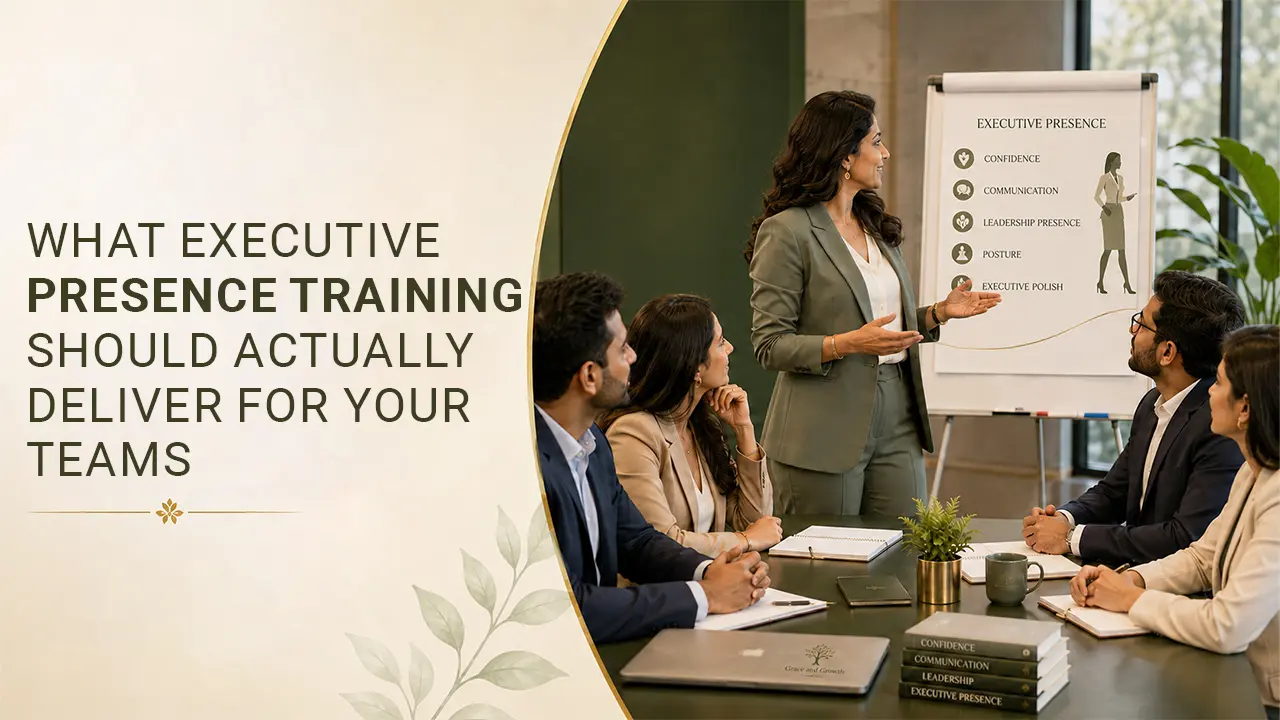
If you’ve ever sat through a post-training feedback form that scored 4.6 out of 5, only to watch the same manager freeze up in the next leadership review, you already know the problem this article is about. Executive presence training gets bought fairly often and delivered reasonably well, yet it rarely changes how people actually show up six months later. That gap usually isn’t the team’s fault. It’s usually the program.
Most executive presence training is built as a single workshop: a few hours on posture, a slide deck on communication, maybe a role play or two, and then everyone goes back to their desks. It photographs well for the internal newsletter, but it rarely survives contact with a real client meeting or a tense leadership review. For HR and L&D leaders, the harder job isn’t finding a vendor who can run a workshop. It’s finding one whose training actually sticks.
This guide walks through what executive presence training should include for corporate teams, the questions worth asking before you sign off on a vendor, and what tends to separate programs that create lasting change from ones that generate a nice feedback score and not much else.
Why Executive Presence Training Matters More Than Most L&D Budgets Reflect
Technical competence gets people hired. Executive presence is often what decides who gets promoted, who leads the client relationship, and who represents the company in the room that actually matters. Most organisations already know this intuitively, which is why leadership assessments so often include some version of “needs more gravitas” or “presence doesn’t match potential,” usually without a clear path to fix it.
A few reasons this keeps landing on HR and L&D’s desk:
- Promotion readiness gaps. Technically strong managers get passed over for leadership roles because they don’t yet project the confidence or communication the next level requires.
- Client-facing risk. In consulting, BFSI, and other relationship-driven sectors, a junior team member’s presence in the room can shape a client’s confidence in the whole account.
- Uneven leadership pipelines. Some high performers naturally carry themselves with authority. Others, often equally capable, get overlooked simply because presence was never formally taught to them.
- Retention of high-potential talent. Employees who feel underprepared for visibility and leadership moments are more likely to plateau, disengage, or leave for a role where they feel more set up to succeed.
None of this is about turning employees into a different version of themselves. It’s about closing the gap between actual capability and how consistently that capability comes through in a room, which is exactly the space our Professional Excellence programme was built for.
Why Most Corporate Executive Presence Training Doesn’t Stick
Before looking at what to look for, it’s worth naming why so many well-intentioned programs fall flat.
It’s Treated as a One-Off Event, Not a Habit-Building Process
A single half-day workshop can raise awareness, but presence is built through repetition, feedback and practice, not a single afternoon of tips. Without follow-through, most of what’s covered fades within a few weeks.
It Teaches Skills in Isolation
Many vendors split communication, body language, and etiquette into separate, disconnected modules. In real interactions, none of these show up on their own. A manager’s posture, tone and word choice all land on a client at the same time, so training that treats them separately tends to produce awkward, half-applied behaviour rather than a natural, integrated presence.
It’s Generic Rather Than Role-Specific
A frontline customer service team, a mid-management cohort preparing for their first leadership role, and a senior leadership group navigating investor rooms all need genuinely different training, not the same generic deck with the company logo swapped in.
There’s No Way to Measure Whether It Worked
Feedback forms measure how the session felt, not whether behaviour actually changed. Without some form of pre and post assessment, or manager observation built into the program, it’s difficult to know if the investment produced anything beyond a pleasant afternoon.
What HR and L&D Leaders Should Look For in an Executive Presence Training Partner
A Holistic Approach, Not a Checklist of Tips
Ask whether the program treats body language, communication, etiquette and confidence as one connected system, or as separate modules bolted together. Presence shows up as a whole in every interaction, so training that mirrors that reality tends to transfer far better into daily work than a checklist-style workshop does.
Customisation to Your Teams and Roles
A strong vendor will ask about your industry, your client base, and the specific moments where presence matters most for each cohort, before designing anything. If a vendor proposes the same session for your frontline team and your senior leadership group without adjusting the content, that’s usually a sign the program hasn’t been built around your organisation at all.
Experience With Corporate Audiences, Not Just Individual Clients
Coaching one professional in a private session is a different skill from holding a room of thirty people across different seniority levels, personalities and comfort zones. Ask for examples of corporate group work specifically, not just individual coaching testimonials.
A Practical, Experiential Format
Look for role plays, real business scenarios, dining etiquette practice, and one-on-one coaching moments built into the session, not a lecture with a slide deck. Adults retain far more from doing something imperfectly and getting feedback than from watching someone else demonstrate it.
Flexibility Across Delivery Formats
Some cohorts need a single intensive workshop. Others benefit more from a program spread across several sessions with reinforcement in between. A good partner will recommend the format that fits your calendar and your goals, rather than pushing a single fixed structure regardless of your needs.
A Credible, Experienced Facilitator
Ask who’s actually running the sessions and what their background is, ideally someone with real experience across image consulting, communication coaching and corporate training, not a generalist reading from a licensed slide deck. The facilitator’s own presence in the room is, in a very real sense, part of what’s being sold.
Some Mechanism for Follow-Through
Even a short post-training check-in, a manager debrief, or a simple set of practice prompts can meaningfully improve how much of the training actually gets used. Ask what happens after the session ends, not just what happens during it.
Structuring Executive Presence Training Across Different Team Levels
Not every cohort needs the same emphasis. A useful starting point when briefing a vendor:
| Team Level | Primary Focus | Typical Format |
| Frontline and customer-facing staff | First impressions, workplace etiquette, tone and body language in customer interactions | Group workshops, role play heavy |
| Mid-management, promotion-track employees | Meeting presence, persuasive communication, confidence under scrutiny | Small group coaching plus group workshops |
| Senior leadership and client-facing executives | Boardroom gravitas, investor and client room presence, composure under pressure | Small group or one-on-one coaching |
| Entrepreneurs and founder-led teams | Pitching, representing the brand, leading with authority | One-on-one coaching, occasionally paired with team sessions |
A single vendor offering flexibility across all four rows tends to be more useful long term than juggling different specialists for each level, since the underlying philosophy and language around presence stays consistent across the organisation.
Signs a Program Will Actually Create Change
- The vendor asks detailed questions about your teams before proposing a format, rather than pitching a fixed package immediately.
- The proposal includes practice, role play or real scenario work, not just a presentation.
- There’s some plan for what happens after the session, even something simple.
- The facilitator has visible experience with corporate groups, not only individual clients.
- The content can flex by seniority level rather than staying identical across every cohort.
- References or past corporate clients are available and specific, not vague.
Red Flags Worth Asking About
- A single fixed workshop pitched as a complete solution for every team and seniority level.
- No mention of follow-up, reinforcement, or how success will be measured.
- Content that separates communication, etiquette and body language into disconnected sessions with no integration.
- A facilitator whose experience is entirely theoretical, certifications without visible corporate delivery experience.
- Vague outcomes like “boost confidence” with nothing more specific about what changes in behaviour.
How Grace & Growth Partners With HR and L&D Teams
At Grace & Growth, our Professional Excellence programme is built specifically to flex across individual professionals, entrepreneurs, frontline teams and full organisations, led by founder Mansi Mehta, a personality development coach and image consultant working across both individual and corporate engagements.
Sessions are experiential rather than lecture-based: role plays, real business scenarios, dining etiquette practice and one-on-one coaching moments, delivered as small group coaching or full corporate workshops depending on what your team needs. The programme draws on Body Language & Presence Training, Soft Skills & Social Intelligence and Modern Etiquette & Social Presence, treated as one connected system rather than separate modules, so training transfers into how your teams actually show up in client meetings and leadership rooms, not just in the workshop itself.
If you’re evaluating options for your organisation, it’s worth starting with a conversation about your specific teams and goals rather than a standard proposal. Book a consultation with Grace & Growth to discuss what executive presence training could look like for your teams.
Frequently Asked Questions
- What is executive presence training for corporate teams? It’s structured training that helps employees develop how they communicate, carry themselves and are perceived in professional settings, typically covering body language, communication, etiquette and confidence, adapted for group or organisational delivery rather than individual coaching alone.
- How is corporate executive presence training different from individual coaching? Corporate training is designed for group delivery across multiple participants and often multiple seniority levels at once, and needs to account for different roles, comfort levels and goals within the same session, unlike one-on-one coaching, which can be built entirely around a single person.
- What should HR and L&D leaders ask vendors before choosing an executive presence training program? Key questions include how the program will be customised to your teams, what experience the facilitator has with corporate audiences, whether the format includes practical role play, and what happens after the session to reinforce what was taught.
- How long should a corporate executive presence training program run? This depends on the goal. A single workshop can raise awareness, but building lasting change generally needs either a program spread across multiple sessions or some form of follow-up and reinforcement built in, rather than a single stand-alone event.
- Can executive presence training be customised for different seniority levels within the same organisation? Yes, and it generally should be. Frontline teams, mid-management and senior leadership typically need different emphasis, frontline staff often focus on first impressions and etiquette, while senior leaders focus more on boardroom gravitas and composure under pressure.
- How do you measure whether executive presence training worked? Feedback forms measure how a session felt, not whether behaviour changed. More reliable signals include manager observations over the following months, self-reported confidence in specific situations, and whether participants use the specific techniques taught in real meetings or client interactions.
- Is executive presence training only useful for senior leadership? No. It’s often most valuable for promotion-track managers and client-facing staff at every level, since presence gaps tend to show up earliest in meetings, client interactions and visibility moments long before someone reaches senior leadership.
- What industries benefit most from corporate executive presence training? Relationship-driven sectors like BFSI, consulting, luxury retail and client services tend to see the most direct impact, though any organisation with client-facing roles, leadership pipelines or frontline customer interactions benefits from it.
- Should executive presence training be combined with etiquette or communication training? Ideally yes. Presence, communication and etiquette all show up together in real interactions, so training that integrates them tends to transfer into daily work far better than separate, disconnected workshops on each topic.
- How much does corporate executive presence training typically cost? (Grace & Growth input required: please confirm pricing structure, whether it’s per participant, per session or per organisation, and any factors like group size or number of sessions that affect cost, so this answer reflects your actual offering.)
- Can executive presence training be delivered online for distributed or hybrid teams?